
Septum — Benchmark Results
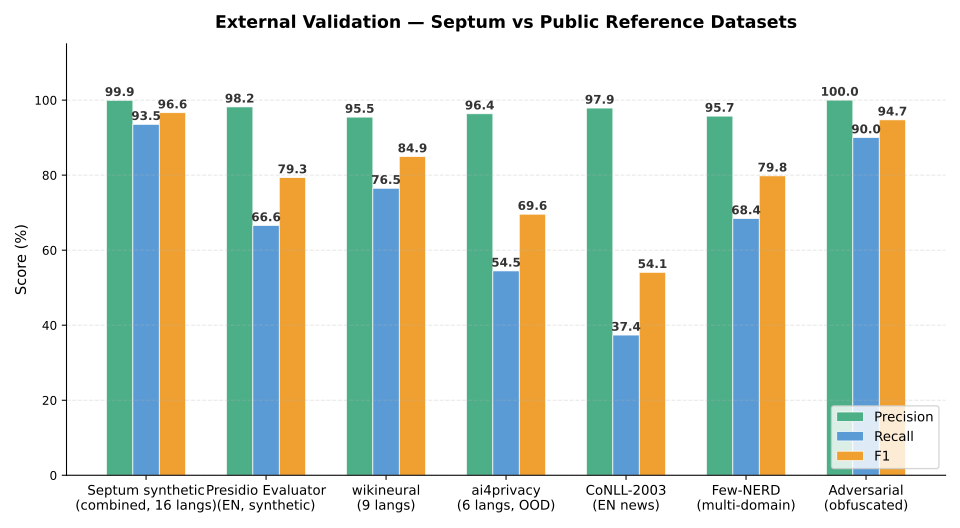
All 17 built-in regulations active, evaluated across five independent data sources plus two robustness probes:
- Septum synthetic corpus — 3,468 algorithmically generated PII values across 23 entity types in 16 languages (ar, de, en, es, fr, hi, it, ja, ko, nl, pl, pt, ru, th, tr, zh). The only way to cover checksummed IDs (valid Luhn, IBAN MOD-97, TCKN) that no public dataset carries, plus a 31-doc semantic-contextual subset (60 entities across DIAGNOSIS / MEDICATION / RELIGION / POLITICAL_OPINION / ETHNICITY / SEXUAL_ORIENTATION) that measures Ollama's unique contribution. Fixed seed — fully reproducible.
- Microsoft presidio-evaluator — 200 synthetic Faker sentences, the reference PII evaluation framework used by the Presidio team. Entity map excludes DATE_TIME / TIME / TITLE / SEX / CARDISSUER / NRP — labels that are not PII under any of Septum's 17 regulations — so the recall number reflects masking quality, not category mismatches.
- Babelscape/wikineural — 50 Wikipedia held-out sentences × 9 languages. Caveat: the XLM-RoBERTa NER models Septum uses were trained on the related WikiANN corpus, so these numbers skew toward an upper bound on real-world performance for this language set.
- ai4privacy/pii-masking-300k — 50 validation samples × 6 languages (en/de/fr/es/it/nl). Modern PII-specific dataset built from scratch; the models Septum uses were NOT trained on it, so this is the closest the benchmark gets to a true out-of-distribution check.
- CoNLL-2003 — 200 samples from the classical EN news-domain held-out test split. Not in any Septum-relevant training corpus.
- DFKI-SLT/few-nerd (supervised split) — multi-domain Wikipedia NER used as a cross-domain robustness probe. Only person / organization / location map to Septum's PII categories.
- Robustness probes — 15 PII-free paragraphs in 9 languages (false-positive rate) + 18 obfuscated PII inputs (leetspeak, Unicode homoglyphs, zero-width joiners, mixed-case emails, bracketed emails, escaped credit cards, line-wrapped TCKNs and IBANs, international phone formats, "at / dot" ASCII obfuscation).
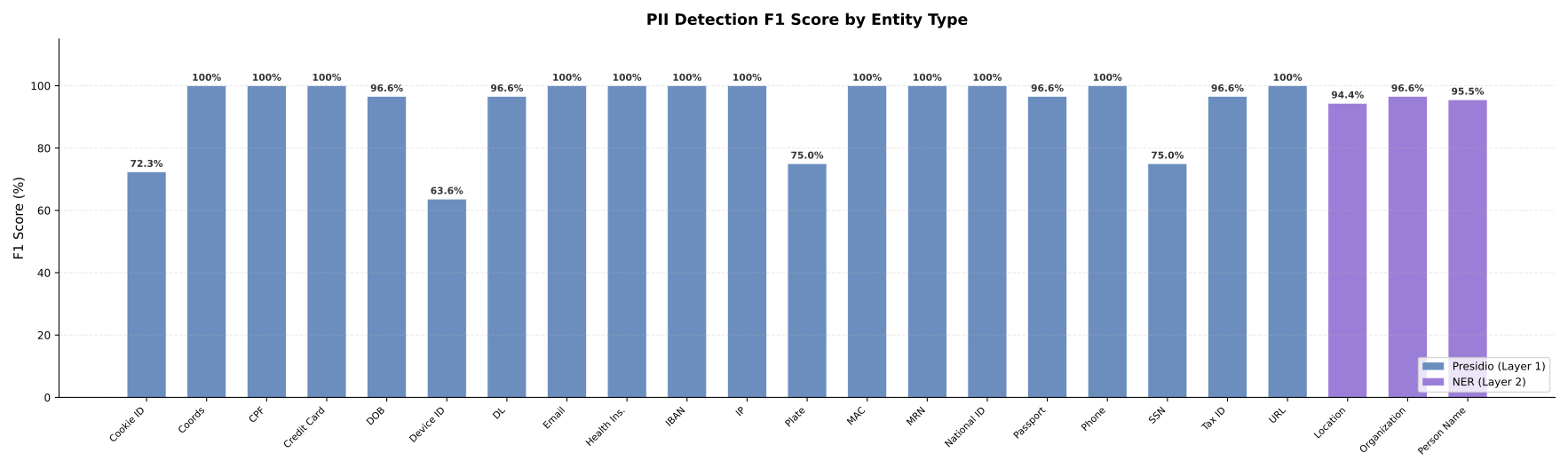
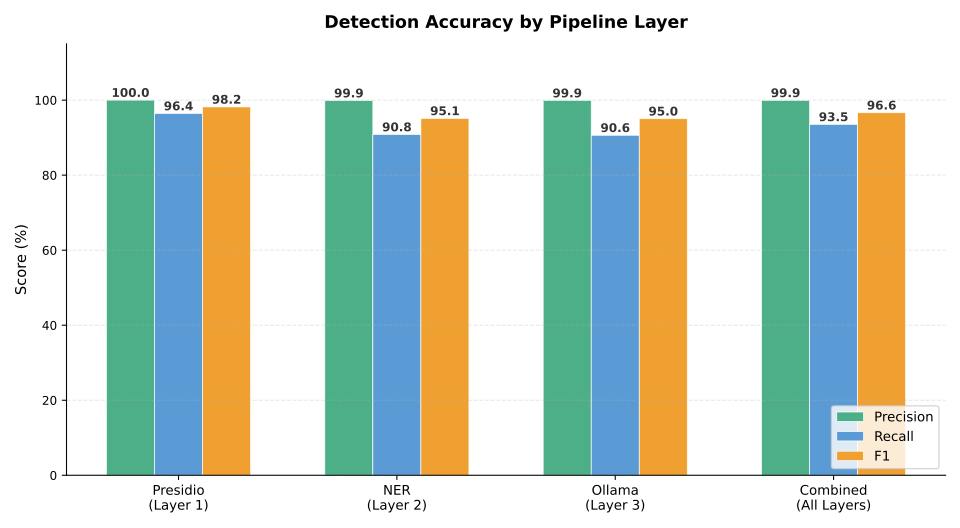
Septum synthetic corpus (per-layer)
| Layer | Entities | Types | Precision | Recall | F1 |
|---|---|---|---|---|---|
| Presidio (L1) — patterns + validators (controlled + extended + adversarial) | 1,710 | 20 | 100% | 96.4% | 98.2% |
| NER (L2) — XLM-RoBERTa + ALL CAPS normalisation (16 languages) | 840 | 3 | 99.9% | 90.8% | 95.1% |
| Ollama (L3) — aya-expanse:8b (alias + semantic-contextual) | 918 | 9 | 99.9% | 90.6% | 95.0% |
| Combined | 3,468 | 23 | 99.9% | 93.5% | 96.6% |
Ollama semantic subset (DIAGNOSIS / MEDICATION / RELIGION / POLITICAL_OPINION / ETHNICITY / SEXUAL_ORIENTATION — entity types Presidio and NER cannot express): 60 entities across 31 docs, F1 96.6% (Precision 98.3%, Recall 95.0%).
Ollama ablation — same 205-doc corpus (semantic + alias + NER) with Ollama OFF vs ON: +3.49 pp recall, +1.95 pp F1. This is the honest measurement of Ollama's marginal value; on the semantic subset alone Ollama lifts recall from near-zero to 95% because no other layer can express those categories.
External reference datasets
| Source | Entities | Types | Precision | Recall | F1 |
|---|---|---|---|---|---|
| Microsoft presidio-evaluator (EN, synthetic Faker, 200 samples) | 326 | 11 | 98.2% | 66.6% | 79.3% |
| Babelscape/wikineural (9 langs × 50 = 450 samples, held-out Wikipedia NER) | 634 | 3 | 95.5% | 76.5% | 84.9% |
| ai4privacy/pii-masking-300k (6 langs, real OOD — not in training data) | 1,456 | 12 | 96.4% | 54.5% | 69.6% |
| CoNLL-2003 (EN news, 372 PER/ORG/LOC scored + 35 MISC excluded by design) | 372 | 3 | 97.9% | 37.4% | 54.1% |
| DFKI-SLT/few-nerd (multi-domain Wikipedia, 200 test samples) | 361 | 3 | 95.7% | 68.4% | 79.8% |
CoNLL-2003 recall is partly structural: 35 of 407 gold entities (8.6%) are MISC-class — nationalities, events, works-of-art — that are not PII under any of Septum's 17 regulation packs and are intentionally excluded from scoring. The headline 54.1% reflects recall after MISC is dropped and combines (a) Septum's deliberate policy that bare place names in free news text are not PII by themselves (GDPR Art. 4(1) rationale) with (b) the conservative LOCATION / ORGANIZATION gates on short single-token mentions. Ai4Privacy exposes real gaps around USERNAME and fine-grained address sub-types that the current regulation packs do not target directly — that's actionable signal, not a rounding error.
Robustness
| Probe | Volume | Result |
|---|---|---|
| Clean-text false-positive rate (15 PII-free paragraphs, 439 tokens across 9 languages) | 0 FP | 0.00 FP / 1k tokens |
| Adversarial pack (18 realistic obfuscated PII inputs: leetspeak, Unicode homoglyphs, zero-width joiners, mixed-case emails, bracketed emails, escaped credit cards, line-wrapped TCKNs and IBANs, international phone formats, "at / dot" ASCII obfuscation) | 20 planted | P 100% · R 90.0% · F1 94.7% |
The adversarial pack is intentionally biased toward the attempts a real user or attacker would type — contrived triple-spaced IBANs and other "nobody would actually paste this" constructions are excluded so the score reflects real-world resilience rather than stress-test theatre. The 10% recall gap is where an obfuscation-normalising custom-rules layer would pay off.
Per-language breakdown (Ollama pipeline)
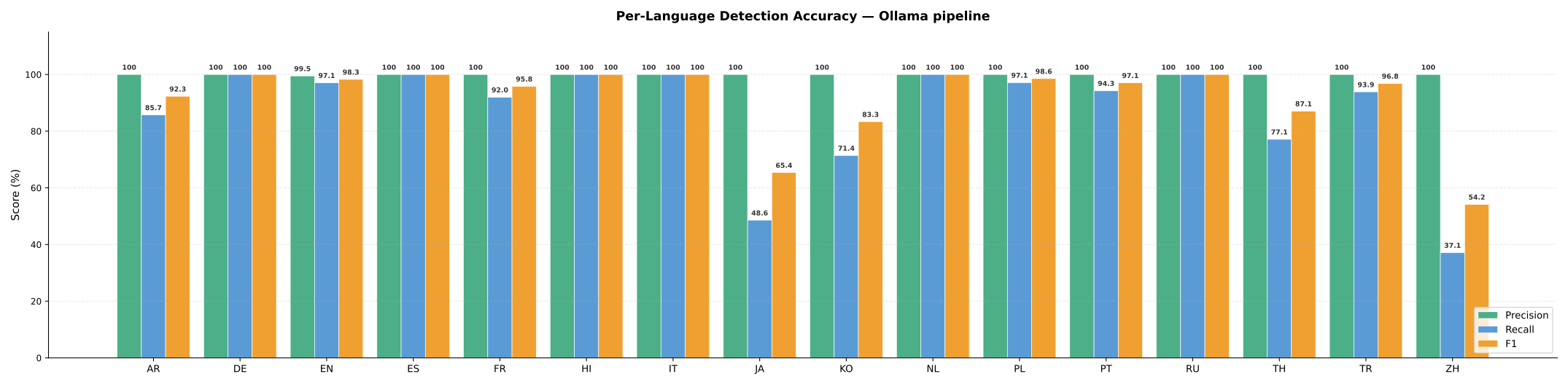
F1 is uniform and very high across Latin-script languages (EN 98.3%, DE 100%, ES 100%, FR 95.8%, IT 100%, NL 100%, PL 98.6%, PT 97.1%, RU 100%, TR 96.8%) and remains strong on Arabic (92.3%) and Hindi (100%). The honest weak spots are CJK and Thai: Thai 87.1%, Korean 83.3%, Japanese 65.4%, Chinese 54.2%. The CJK minimum-span-length floor is now language-aware (2 glyphs for ZH / JA / KO / TH, 3 elsewhere) which already lifted Chinese from 44.4% to 54.2%; closing the rest of the gap requires per-language NER fine-tuning, which is on the roadmap, not claimed to be solved today.
NER (L2) detects ALL CAPS names (common in medical/legal documents) via automatic titlecase normalisation, and recognises organisation names. LOCATION output goes through a conservative gate (multi-word OR confidence ≥ 0.95) so common-noun mis-fires like Turkish "Doğum" or German form headers are filtered out while real placenames like "İstanbul", "Berlin" still pass through. Ollama (L3) validates candidates and catches aliases. Benchmark includes adversarial edge cases (spaced IBANs, dotted phone numbers, etc.) that lower Presidio recall to real-world levels. Reproducible:
pytest packages/api/tests/benchmark_detection.py -v -s
Coverage & limitations
No PII detection system is 100% accurate. Septum's benchmark is transparent about where it wins and where it does not:
- LOCATION output passes through a multi-word-or-high-score gate (same shape as ORGANIZATION_NAME). Multilingual XLM-RoBERTa models produce stochastic single-token LOC mis-fires on common nouns and form-field headers in every language Septum supports (Turkish "Doğum", German form headers, etc.); chasing those per-language via stopword lists does not scale across the 50+ locales the middleware must handle. The gate drops single-token spans below 0.95 confidence — real placenames like "İstanbul", "Berlin" routinely score 0.97+ and multi-word locations ("New York") bypass the score gate entirely. Structured address PII is additionally captured by Presidio's
StructuralAddressRecognizerand the per-regulation POSTAL_ADDRESS / STREET_ADDRESS recognisers. - All 37 regulation entity types are detectable — 21 via Presidio, 3 via NER, 9 via Ollama, and the rest via parent-type coverage (FIRST_NAME by PERSON_NAME, CITY by LOCATION, etc.).
- 23 entity types are actively benchmarked across 3,468 values in 16 languages with adversarial edge cases.
- Semantic types (DIAGNOSIS, MEDICATION, RELIGION, POLITICAL_OPINION) are detected only by the Ollama layer and require a local LLM to be running.
- Context-dependent recognisers (DATE_OF_BIRTH, PASSPORT_NUMBER, SSN, TAX_ID) require contextual keywords near the value to reduce false positives. Multilingual keyword lists cover 8+ languages.
- Adversarial formats (spaced TCKNs, dotted phone numbers) show lower detection rates than controlled-format tests. Reported honestly in the benchmark.
The Approval Gate is the safety net. Before any text is sent to the LLM, you see exactly what will be transmitted and can reject it. Automated detection reduces risk; human review eliminates it.
Benchmark models: NER uses akdeniz27/xlm-roberta-base-turkish-ner (TR) and Davlan/xlm-roberta-base-wikiann-ner (all other languages). Ollama layer uses aya-expanse:8b. Larger Ollama models generally improve semantic detection at the cost of latency.
Ollama model comparison (L3 layer)
The L3 semantic layer is model-pluggable; the harness accepts SEPTUM_BENCHMARK_OLLAMA_MODEL=<model> to swap the candidate. Run the multi-model driver and the table below will be filled from live results on your hardware:
./scripts/benchmark_ollama_models.sh                          # default trio
./scripts/benchmark_ollama_models.sh llama3.2:3b qwen2.5:14b # custom set| Model | Params | VRAM ≈ | Precision | Recall | F1 | Notes |
|---|---|---|---|---|---|---|
llama3.2:3b | 3 B | 3 GB | TBD | TBD | TBD | Fastest, lowest semantic recall expected |
aya-expanse:8b | 8 B | 5 GB | 99.9% | 90.6% | 95.0% | Current default; multilingual-tuned |
qwen2.5:14b | 14 B | 9 GB | TBD | TBD | TBD | Highest accuracy expected; ~3× latency vs 8 B |
Numbers above the per-layer table reflect the default aya-expanse:8b run; results for the other models depend on the host (CPU / GPU, Ollama version, system prompt locale) and are intentionally left TBD until the user reports them with the runner script. Latency varies linearly with parameter count on CPU; on a single 24 GB GPU, 14 B models still fit but the ~3× longer per-call cost dominates the ingestion pipeline.
Additional references:
- Benchmark harness:
packages/api/tests/benchmark_detection.py - Recognizer packs (per regulation):
packages/core/septum_core/recognizers/ - National ID validators (Luhn, Verhoeff, ISO 7064, TCKN mod-10/mod-11, CPF, NRIC):
packages/core/septum_core/national_ids/ - Per-regulation legal sources for every entity type:
regulation-entity-sources.md - Microsoft Presidio: microsoft/presidio · evaluator: microsoft/presidio-research
- XLM-RoBERTa paper: Conneau et al., Unsupervised Cross-lingual Representation Learning at Scale (ACL 2020)
- CoNLL-2003 shared task paper: Tjong Kim Sang & De Meulder, 2003
- Few-NERD paper: Ding et al., Few-NERD: A Few-shot Named Entity Recognition Dataset (ACL 2021)
- Ai4Privacy dataset card: ai4privacy/pii-masking-300k
- Regulation primary sources: GDPR · KVKK (6698) · HIPAA · CCPA / CPRA · LGPD · UK GDPR · PIPEDA